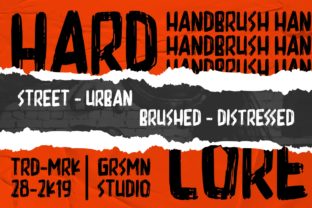
Hardcore: The Urban Display Font That Commands Attention
You know that feeling when you see a design and it just hits different? There's a raw energy, an undeniable presence that stops you mid-scroll or makes you pause on a busy street. That kind of visual punch rarely happens by accident. It's often the result of one critical choice: typography. When a project demands impact over subtlety, when it needs to feel modern, bold, and a little bit gritty, the right font becomes your most powerful ally. Enter Hardcore, an urban display typeface built for exactly these moments.
This isn't your average, polite font that blends into the background. Hardcore is a statement piece. Its letterforms are constructed with a distinct urban sensibility—think bold strokes, sharp geometric influences, and a confident, unapologetic stance. It carries the visual DNA of street art, modern branding, and dynamic digital culture. The appeal lies in its versatility within that boldness. It can feel edgy and rebellious for a streetwear brand, sleek and powerful for a tech startup, or energetic and engaging for a social media campaign. It’s a font that doesn't just display text; it amplifies the message behind it.
Where Hardcore Truly Shines: Practical Applications
Understanding a font's personality is one thing, but knowing where to deploy it is what separates good design from great communication. Hardcore's strength is its ability to inject immediate personality and scale into a project. Its design ensures legibility even at larger display sizes, making it a prime candidate for headlines and key messaging where first impressions are everything.
For branding and logo design, this typeface can be a game-changer. Imagine a fitness brand, a music festival, a creative agency, or a new beverage company. A logo set in Hardcore immediately communicates energy, modernity, and confidence. It helps establish a brand identity that feels current and assertive. The key is to pair it with a more neutral, readable sans serif font or even a clean serif font for body copy, creating a balanced typographic hierarchy that guides the viewer's eye.
Think about packaging design. On a crowded shelf, your product has seconds to tell its story. Hardcore, used for the product name or a key slogan, can cut through the visual noise. It's particularly effective for products targeting a younger, style-conscious demographic—think craft beer, artisanal snacks, or specialty cosmetics. The font's urban edge can signal that the brand is fresh, innovative, and not afraid to stand out.
In the digital realm, the applications are endless. Social media graphics live and die by their ability to stop the scroll. A bold quote, a promotional offer, or a podcast title set in Hardcore has the visual weight to do just that. It translates beautifully to web design for hero sections, calls-to-action, and navigation headers that need to be both stylish and highly functional. For blogs and digital publishers, it can be used for article titles and section headings to create a strong, consistent visual rhythm that enhances the reading experience.
Beyond the Screen: Print and Physical Media
Hardcore's utility extends far beyond pixels. In print materials, it excels. Think of posters for events, concerts, or gallery openings. The font's inherent drama commands attention from a distance. For merchandise like t-shirts, hats, or tote bags, it provides a ready-made cool factor. The lettering itself becomes part of the design's aesthetic, requiring less additional illustration to make an impact.
Even in more traditional contexts like invitations or editorial layouts, it can find a place. A bold, stylized header on a wedding website for a modern couple, or a striking pull-quote in a magazine spread, can benefit from its distinctive character. The goal is always to use it strategically—as a highlight, a focal point—not as a replacement for long-form reading text. Its job is to grab attention; other, more neutral fonts should handle the heavy lifting of paragraphs.
Making It Work: Tips for Effective Use
Choosing a premium font like Hardcore is the first step. Using it effectively is the next. Here’s some practical advice to ensure it elevates rather than overwhelms your project.
First, review all included styles and weights. A well-designed display font family often includes variations—like regular, bold, italic, or outline—that give you creative flexibility. Using an outline style for a headline with a solid fill for a subhead can create sophisticated depth.
Second, font pairing is crucial. Because Hardcore has such a strong personality, it pairs best with quieter, more versatile companions. A classic sans serif font like Helvetica, Arial, or a geometric sans for body text provides excellent readability and lets the display font shine. For a more dramatic or editorial feel, pairing it with a elegant script font or a refined serif font can create a beautiful contrast, though this requires a careful eye to avoid clash.
Third, always test for readability in context. While it's designed for impact, you still need to ensure your message is clear. View your designs at the intended size—on a phone screen, on a mockup of a poster, in a print proof. Check letter spacing (tracking) and line height (leading) to make sure the text is comfortable to read, even in short bursts.
Finally, consider commercial licensing. If you're using this for a client project, merchandise, or a business asset, ensure you have the appropriate license. Reputable font foundries are clear about their terms, and respecting them is part of professional practice. It protects you, supports the creators who made the tool, and ensures your project is built on a solid, legal foundation.
Ultimately, a font like Hardcore is more than just a set of letters. It's a design asset, a tool for visual communication